
What Your Urine Reveals About Hydration and Water Quality
Nobody likes staring into a toilet bowl - but that quick peek before hitting the flush lever can actually be a more telling indicator of what's going on inside your body than most people realise, especially when it comes to hydration levels and whether tap water quality is actually doing more harm than good. Recall those urine color charts you see plastered up in gyms, military barracks, doctors' surgeries, and old folks' homes. Well, athletes live by them, and coaches often put them on the locker room wall - and even doctors use them as a quick way to get a read on patients’ health.
Tit all comes back to the fact that the color of your wee provides instant feedback on your hydration levels without you having to spend a penny on blood tests, lab work, or fancy equipment. What usually goes unsaid is the fact that water quality has a real impact on how well you hydrate and what ends up in your wee.
Tap water or well water contaminants can really mess with your kidney function, how your body absorbs nutrients, and your overall health. But you'd be amazed at how few people actually check whether their tap water might be effectively sabotaging their hydration efforts because they're drinking the "right" amount daily.
Urine as a Hydration Indicator
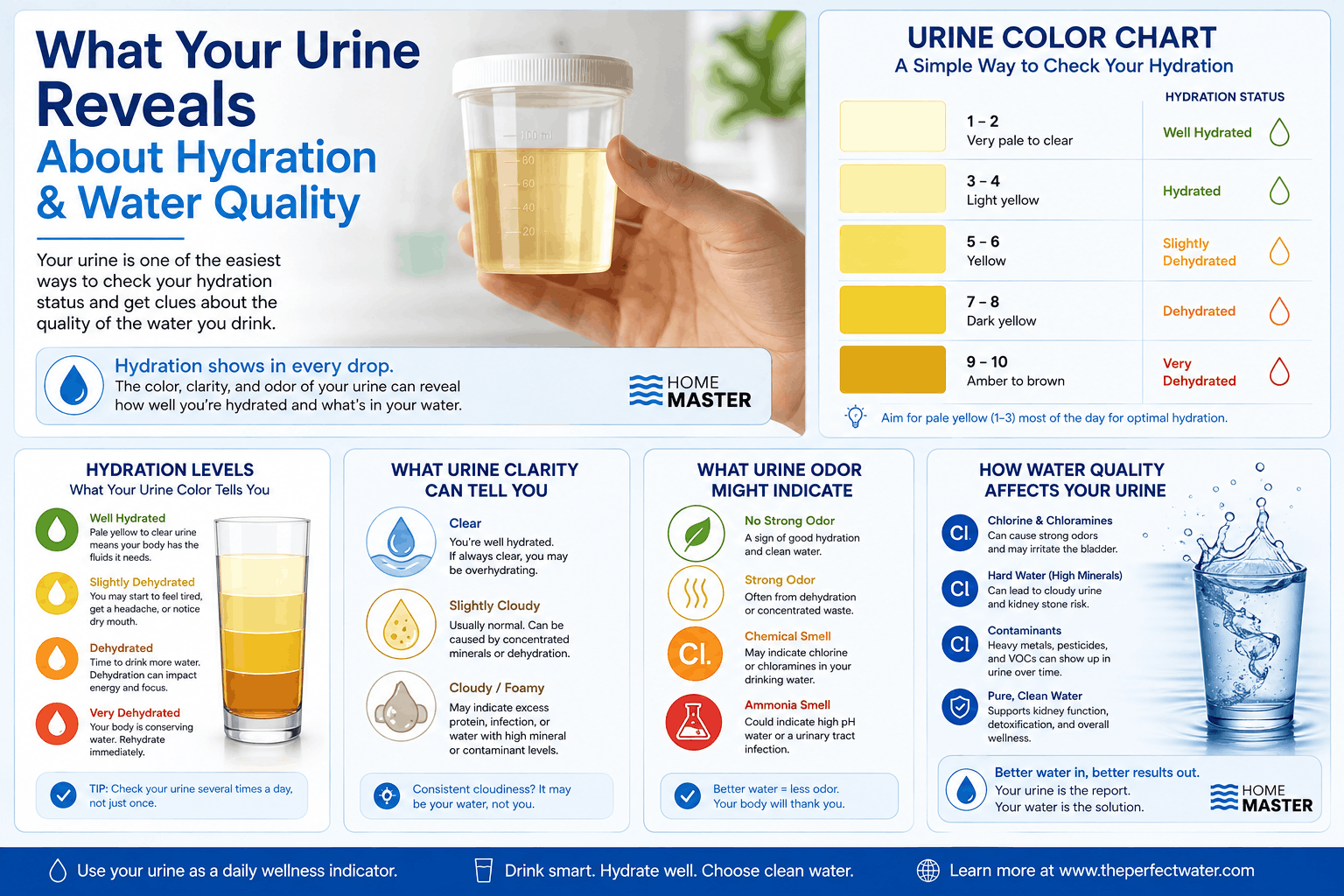
Back in the late 1980s, University of Connecticut researcher Lawrence Armstrong was analyzing urine samples when afternoon sunlight streaming through a window hit the containers. Colored patches appeared on his lab table. Noticing how intensity matched concentration levels, he arranged samples from light to dark. That spontaneous observation led to the original eight-color chart now used worldwide, according to Arizona State University.
The biochemistry is straightforward. Urine gets its yellow color from urochrome, a pigment created when hemoglobin breaks down. Research in Frontiers in Nutrition explains what happens during dehydration: the hormone arginine vasopressin increases, signaling the kidneys to reabsorb more water. This concentrates urochrome. More pigment in less volume equals a darker color.
Studies demonstrate urine color correlates strongly with established hydration measures: correlation coefficients above 0.70 when compared against urine osmolality and specific gravity. Translation: checking color provides remarkably accurate hydration feedback without needing laboratory analysis.
Research involving 474 elite athletes published in PMC tracked urine changes as dehydration progressed. Color gradually darkened. Brightness decreased. Yellow intensity increased. The study defined optimal hydration as specific gravity between 1.010-1.020 and osmolality between 500-700 mmol/kg.
Pale yellow (often called "straw-colored") indicates good hydration. Medium yellow suggests mild dehydration, not emergency-level but worth addressing. Dark yellow or amber signals a more significant fluid deficit requiring immediate attention. Healthdirect Australia notes that darker, strong-smelling urine in small amounts can indicate dehydration needing immediate fluid intake.
Timing affects accuracy when checking color. Morning urine typically appears darker because the body concentrates urine overnight during hours without drinking. That's normal physiology, not cause for alarm. Checking throughout the day provides a better overall assessment.
Several factors besides dehydration affect color, though. B vitamins create bright yellow or greenish urine. Certain medications change it. Beets turn urine pink or red. Dehydration isn't the only explanation for color changes. Just one of the most common and easiest to address.
How Water Quality Influences Urine
Two people drinking identical volumes of water daily might show completely different hydration levels on urine tests. Why? Water quality affects how efficiently the body absorbs and utilizes fluid at the cellular level.
Municipal water gets a chemical treatment to knock out any nasty bacteria that might be lurking around - chlorine and chloramines are the usual culprits. These disinfectants do a crucial job keeping us safe from cholera and similar horrors – we don't want to see a comeback for any of those nasty diseases. But the important thing to note is that these chemical disinfectants don't just magically disappear once the water hits your house - no way. They stay put in your drinking water, messing around with taste and potentially even making it harder for your body to make use of the hydration.
Research is pretty clear that chlorine interferes with your gut microbiome - that's the orchestra of good and bad bacteria in your digestive system that helps you absorb nutrients and keep your immune system ticking over. If that balance gets all out of whack, your body might struggle to get the most out of the water you're drinking. And what's the point in diligent hydration if your cells can't even make use of it?
Heavy metals present persistent concerns. Lead leaches from pipes installed decades ago. Copper enters water from fixtures and plumbing connections. These metals accumulate in tissues gradually, contributing to oxidative stress, affecting kidney function. Kidneys filter blood and regulate fluid balance. When they're stressed by contaminant exposure, hydration efficiency suffers measurably.
Fluoride gets added to many municipal supplies for dental health. Regulated levels are generally considered safe. Individual sensitivity varies wildly, though. Some people experience reduced hydration efficiency with fluoridated water, while others notice no difference.
Hard water contains high mineral concentrations, primarily calcium and magnesium. Not necessarily harmful. These minerals change water's interaction with the body, though. Some research suggests hard water requires a higher total intake to achieve the same cellular hydration as soft or filtered alternatives.
Well water introduces variables like iron, manganese, sulfur compounds, and bacterial contamination. Iron affects taste dramatically, even at concentrations below health advisory levels. Water tasting like rusty nails strongly deters consumption in adequate amounts, period. Yuck, no thanks. Chronic mild dehydration from simple taste aversion shows up as persistently darker urine despite believing intake is sufficient.
Chloramines, increasingly used instead of chlorine because they're more stable in distribution pipes, present unique challenges. Standard carbon filters removing chlorine often fail completely against chloramines. These compounds need specialized catalytic carbon filtration to be eliminated effectively.
Benefits of Drinking Purified Water
Removing contaminants provides measurable benefits extending far beyond improved taste. Clean water hydrates more efficiently because the body doesn't simultaneously work to filter out unwanted substances while trying to absorb moisture.
Kidneys function optimally with clean input. They're already filtering metabolic waste products continuously: urea, creatinine, various byproducts of cellular metabolism. Adding the burden of filtering water contaminants increases stress on these organs substantially. Over the years, this extra workload can reduce their efficiency in regulating hydration and electrolyte balance.
Chlorine-free water doesn't disrupt gut bacteria populations the way chlorinated water might. A healthier microbiome supports better nutrient absorption, including more efficient water uptake at the cellular level. This translates to better overall hydration from the same volume consumed.
Heavy metal removal protects against gradual accumulation in tissues. Lead, mercury, and copper - these contribute to inflammation and oxidative stress affecting the kidneys, liver, brain, and cardiovascular system. Reducing exposure through water filtration decreases this cumulative burden.
Taste influences consumption more than most people acknowledge. clean and fresh tastingWater gets drunk more frequently, and in larger amounts, without conscious effort or reminders. Simply improving taste through effective filtration can dramatically increase daily intake without willpower or compulsion.
For people dealing with chronic mild dehydration, evidenced by consistently medium to dark yellow urine despite believing they drink enough, switching to purified water often produces noticeable improvement within days. Urine lightens as cellular hydration improves, even without consciously increasing intake volume.
The Role of Reverse Osmosis Systems
Different filtration methods remove different contaminants with widely varying effectiveness. Basic pitcher filters catch some chlorine, but miss most everything else. Faucet-mount filters do slightly better. Reverse osmosis provides the most comprehensive residential option for removing dissolved solids, chemicals, heavy metals, microorganisms, pharmaceuticals, and microplastics.
An under-sink reverse osmosis system like the Home Master HydroPerfection uses nine stages of filtration, purification, and UV sterilization, removing up to 99% of contaminants. The RO membrane, the critical component, works at the molecular level. Water molecules pass through. Larger molecules, including dissolved minerals, chemicals, metals, and microorganisms, get blocked.
This system employs a KDF85 iron filter, removing dissolved iron up to 1 ppm before water even reaches the membrane. Critical for well water users whose water quality might otherwise discourage adequate consumption due to metallic taste and orange staining.
UV sterilization adds protection against biological contaminants. The EPA-registered LED UV chamber destroys 99.99% of bacteria, viruses, and microorganisms without dispensing hot water or adding chemicals. It addresses concerns about pathogens affecting gut health and immune function.
Standard RO systems produce demineralized water, exceptionally pure but slightly acidic and flat-tasting. The HydroPerfection addresses this limitation through a patented remineralization system. Calcium and magnesium get added twice: once as water enters the storage tank, preventing acidic water from degrading rubber tank components, and again as water flows to the faucet. Creates mineral water with 30-60 mg/L combined content, tasting better and hydrating more effectively than demineralized alternatives.
The non-electric permeate pump reduces waste by up to 80% while increasing production by up to 50%. Achieves roughly 1:1 waste-to-purified water ratio. Traditional RO systems waste multiple gallons for every gallon produced, a major environmental concern that this pump addresses directly without requiring electricity.
For households not ready for permanent under-sink installation, countertop options provide substantial improvement. The Home Master Jr. F2 Elite uses five-stage filtration, removing up to 93% of fluoride, aluminum, lead, iron, mercury, copper, chloramines, chlorine, VOCs, THMs, and pharmaceuticals.
This countertop unit employs activated alumina specifically for fluoride removal, catalytic carbon targeting chloramines and chlorine, coconut shell carbon for VOCs and chemicals, plus KDF85 redox media removing soluble heavy metals. The KDF85 also eliminates hydrogen sulfide and creates bacteria-static environments hostile to microorganism growth.
Special channel blockers ensure even filtration throughout the media bed, avoiding channeling problems plaguing competitors' granular filters, where water finds the path of least resistance instead of contacting all filtration media. Connects easily to existing faucets without permanent installation, ideal for rentals, dorm rooms, and temporary situations.
For comprehensive treatment at every outlet, whole-house filtration addresses contaminants before water even reaches individual fixtures. The Home Master HMF3SmgNCC 3-Stage Whole House Filter treats chloramines, chlorine, sediment, pesticides, herbicides, lead, and mercury while maintaining pressure up to 10 gallons per minute.
Massive filter housings with 1-inch ports ensure strong pressure throughout the home. Weak flow discourages adequate water consumption faster than anything else. The multi-gradient sediment filter provides filtration down to 1 micron, followed by a nanofiber filter which filters down to .02 microns - removing viruses, bacteria, cryptosporidium, giardia, fine silt, clay, and rust particles. Also reduces fluoride somewhat at slower flow rates, up to 50% reduction at 5 GPM.
A whole-house approach means every faucet, shower, and appliance receives filtered water. Showering in chlorinated water allows skin and lung absorption of chemicals through warm, open pores and steam inhalation. Whole-house filtration eliminates this exposure entirely.
Practical Hydration & Water Quality Tips
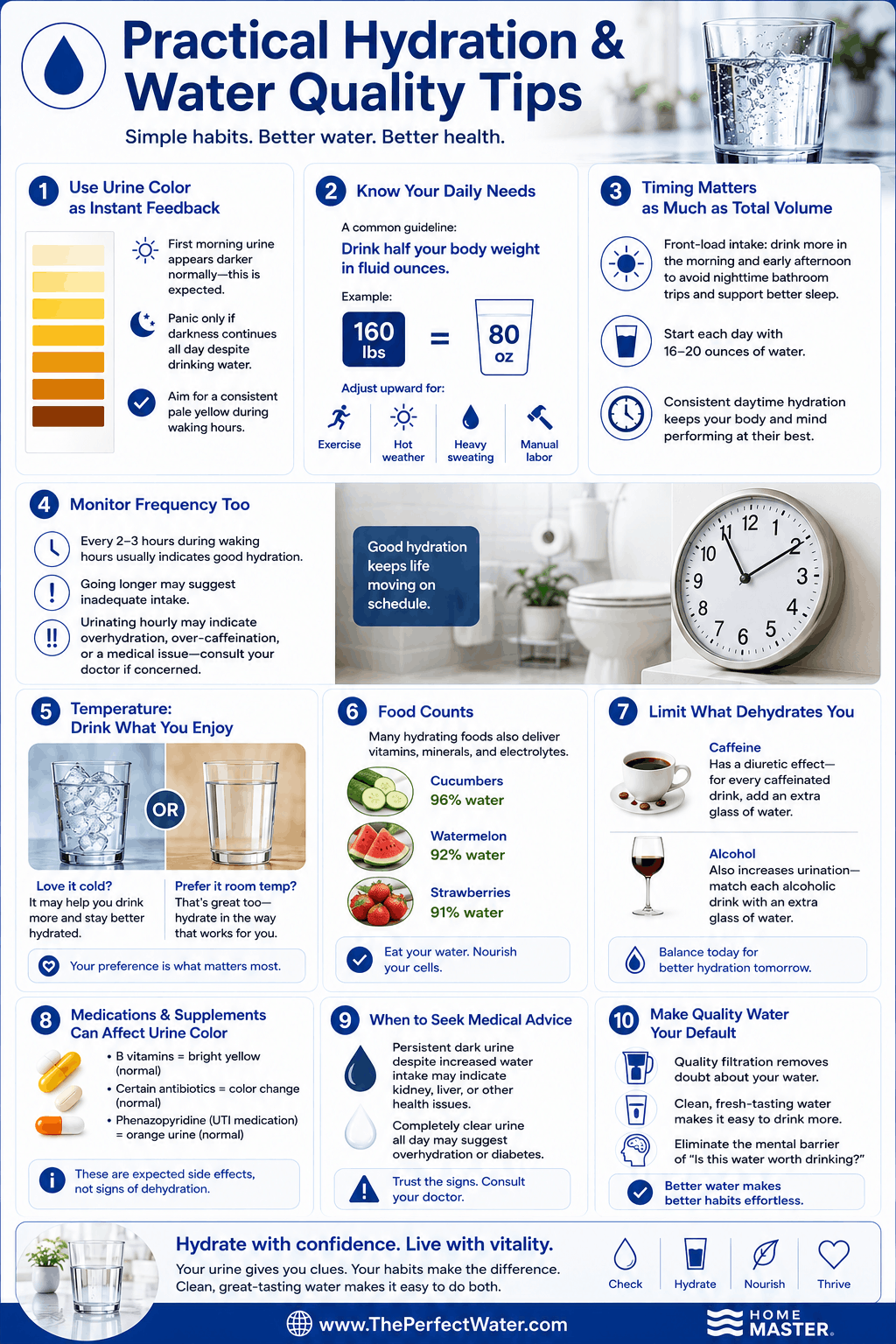
Checking urine color provides immediate feedback, but several factors affect interpretation accuracy. First morning urine appears darker normally (overnight concentration without fluid intake). Dark morning urine is expected. Panic only if darkness continues throughout the day despite drinking water.
Aim for a consistent pale yellow during waking hours. This suggests proper hydration is maintained throughout the day. Checking with each bathroom visit provides ongoing feedback about whether intake needs adjustment upward or whether current habits are working.
Individual needs vary based on body weight, activity level, climate, and metabolism. Common formula: consume half of body weight in fluid ounces daily. Someone weighing 160 pounds needs 80 ounces. Adjust upward for exercise, hot weather, increased perspiration from manual labor, or other factors.
Timing distribution matters as much as total volume. Front-loading intake (drinking more in the morning and early afternoon) prevents nighttime bathroom trips, disrupting sleep, while ensuring adequate daytime hydration. Start each day with 16-20 ounces, addressing overnight fluid loss.
Monitor urination frequency too. Going every 2-3 hours during waking hours generally indicates good hydration. Going longer suggests inadequate intake. Urinating hourly might indicate overhydration, over-caffiniation, or underlying medical issues worth discussing with healthcare providers.
The temperature of the water we drink can have a pretty big impact on how much we end up drinking. For some folks, nothing beats a nice cold glass of water - it's just so refreshing that they end up drinking way more than they would if the water were at room temperature. Others much prefer it at room temperature, finding it easier to drink in volume. Ultimately, it's really all about honoring your personal preference and finding what works for you rather than worrying about some arbitrary temperature that's supposed to be good for you.
You know, we also tend to forget that a lot of the water we need comes not just from drinking plain old water, but from the food we eat. I mean, take cucumbers, for example - 96% water. Watermelon's even closer, at 92%. And strawberries? 91%. These kinds of foods can make a big difference in your daily hydration levels, and they also happen to pack a punch in terms of vitamins, minerals, and electrolytes that are good for your cells.
And then there are the things that can actually make it harder to stay hydrated - like caffeine and alcohol. Both of these have a diuretic effect, which means they make you pee more. So for every caffeinated or alcoholic drink you have, just make sure to drink an extra glass of water to keep things in balance. This is especially true if you notice your pee is getting a lot darker than usual and you're wondering why you're not staying hydrated.
Be aware of medications and supplements affecting urine color independent of hydration status. B vitamins create bright yellow urine. Certain antibiotics change color. Phenazopyridine for urinary tract infections turns urine orange. These don't indicate dehydration. They're expected side effects documented in the medication information.
Persistent dark urine despite increased water intake warrants medical evaluation. Could indicate kidney problems, liver issues, or other conditions requiring professional assessment. Similarly, completely clear urine all day might suggest overhydration or diabetes, both worth discussing with doctors rather than dismissing.
Installing quality filtration removes ongoing decision-making about water quality. When every glass tastes clean and fresh, maintaining adequate intake becomes substantially easier. The mental barrier of questioning whether water is worth drinking gets eliminated entirely.
Conclusion
Urine serves as a remarkably accurate hydration indicator available to everyone without cost, equipment, or special training. Color provides immediate feedback about fluid status, essential for kidney function, cognitive performance, physical endurance, temperature regulation, and overall health maintenance.
Hydration depends on more than just volume consumed, though. Water quality significantly affects how efficiently the body absorbs and utilizes fluid at the cellular level. Contaminants in tap water (chlorine, chloramines, heavy metals, dissolved minerals, organic compounds) can interfere with optimal hydration while adding stress to kidneys and other filtering organs.
Advanced filtration systems addressing these concerns make maintaining proper hydration substantially easier without requiring conscious behavior modification. When water tastes good and doesn't contain substances the body must filter out, consumption increases naturally. Reverse osmosis systems with remineralization provide comprehensive contaminant removal while preserving beneficial minerals supporting cellular hydration and overall health.
The connection between hydration and urine color isn't mysterious. It is a straightforward physiology involving urochrome concentration and kidney function, regulating fluid balance. Monitoring color provides actionable feedback for adjusting intake throughout the day. But that feedback works optimally when water quality supports efficient hydration rather than undermining it through contamination.
For people whose urine consistently appears darker despite drinking recommended amounts, examining water quality might reveal the missing variable. Sometimes the solution isn't drinking more water. It's drinking better water that the body can actually absorb and utilize effectively at the cellular level, where hydration truly occurs.