
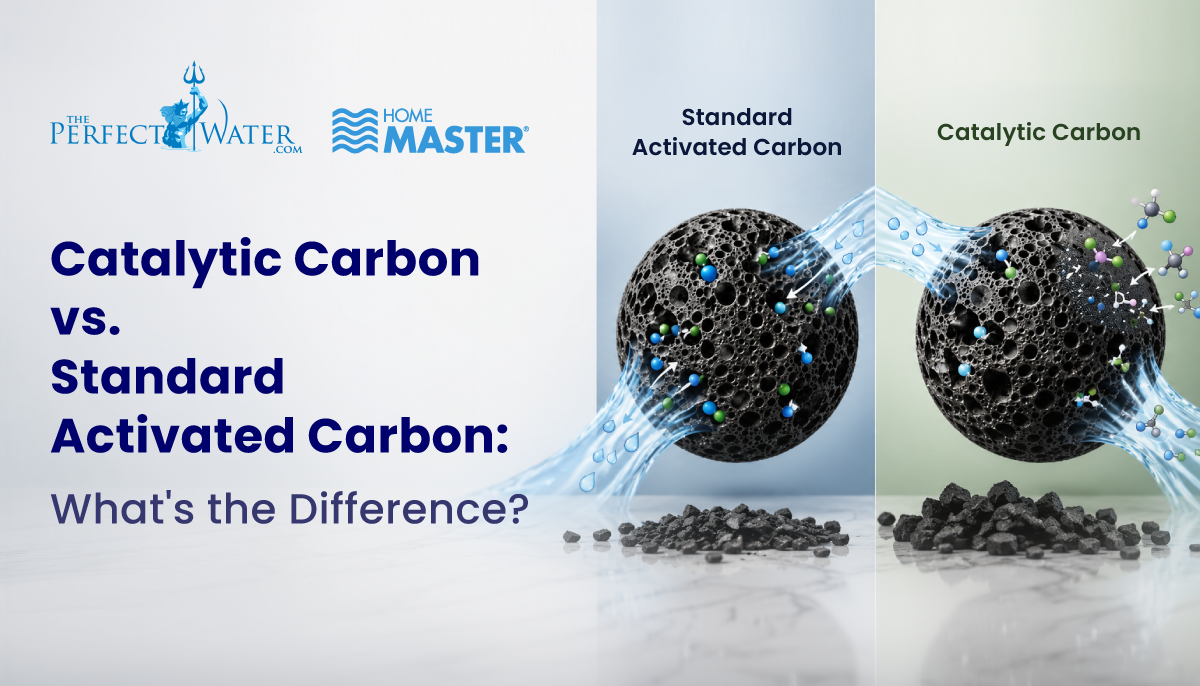
When comparing a catalytic carbon vs. an activated carbon water filter, the biggest difference is chloramine removal. Standard activated carbon is somewhat effective in chlorine removal, but catalytic carbon is made specifically to decompose chloramines, particularly in whole-house water filters where chlorinated municipal water is used.
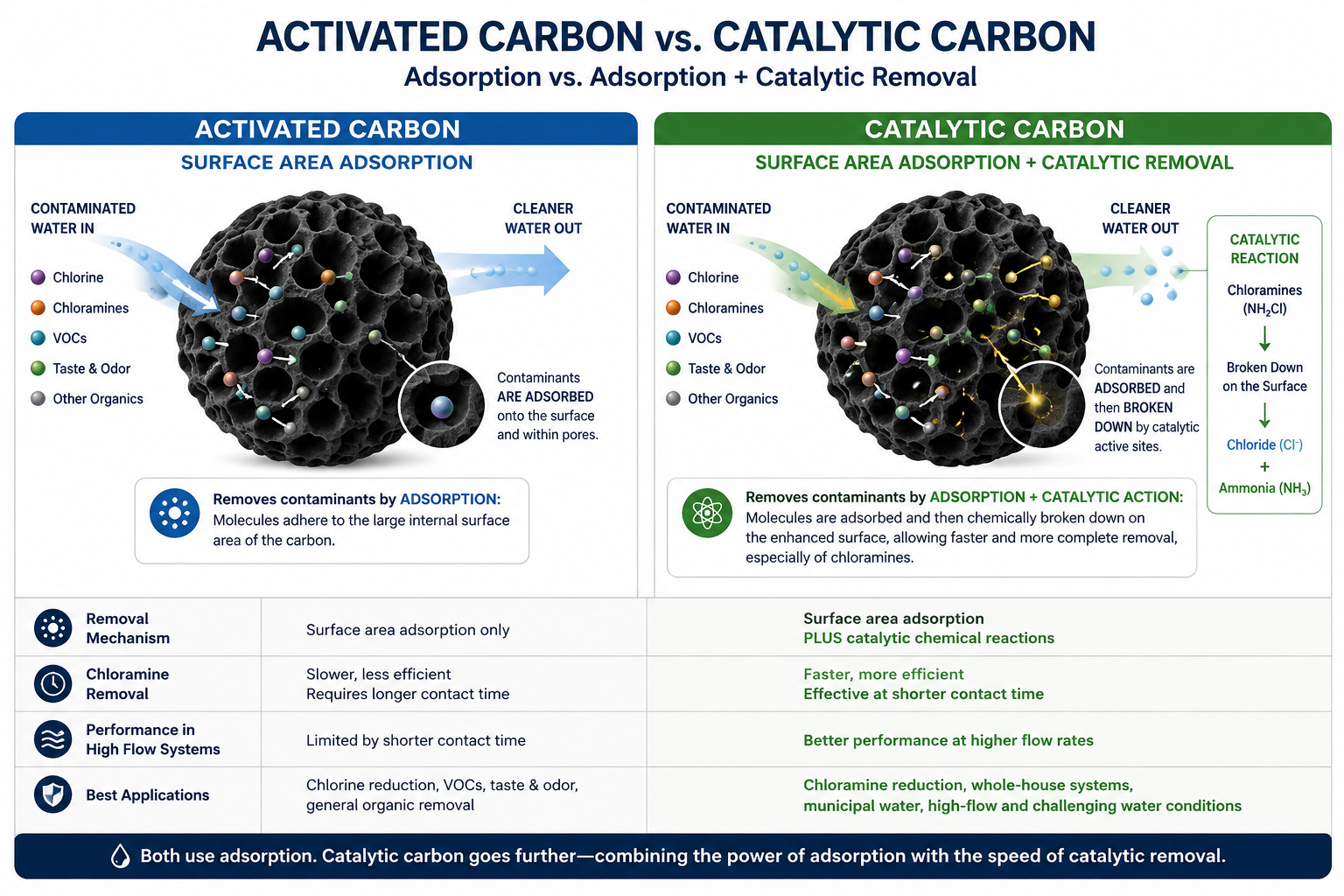
Activated Carbon — Adsorption Process
-
Water flows through highly porous activated carbon with an extensive internal surface area.
-
Chlorine, volatile organic compounds, dissolved gases, and many other chemicals are captured primarily through adsorption, meaning they adhere to the carbon’s surface.
-
Catalytic carbon provides the same adsorption benefits while also promoting chemical reactions that improve the reduction of difficult contaminants such as chloramine and hydrogen sulfide.
-
Iodine rating: Expressed in milligrams per gram (mg/g), the iodine rating indicates the carbon’s relative activation level and capacity to adsorb small molecules within its micropores. A higher number generally indicates greater micropore capacity, but it does not measure every aspect of filtration performance.
Understanding Iodine Ratings
Conventional activated carbon and catalytic carbon frequently have overlapping iodine ratings. Representative conventional water-treatment carbons are rated at approximately 850–1,000 mg/g, while commercial catalytic carbons are commonly rated around 825–900 mg/g. Therefore, catalytic carbon does not necessarily have a higher iodine rating. Its primary advantage is its modified surface chemistry, which promotes reactions that improve chloramine and hydrogen sulfide reduction. The iodine rating should be used to evaluate adsorption capacity, not as the sole measure of overall carbon quality or catalytic performance.
What Is Activated Carbon?
Activated carbon is a filtration medium made from carbon-rich materials such as coconut shells, coal, wood, or peat. It is processed to create a highly porous structure with a large internal surface area.
In water filtration systems, activated carbon primarily works through adsorption. Contaminants attach to the carbon’s internal surface as water passes through the media.
Standard activated carbon is commonly used to reduce:
-
Chlorine
-
Bad taste and odor
-
Volatile organic compounds (VOCs)
-
Pesticides and industrial chemicals
-
Some PFAS compounds
What Is Catalytic Carbon?
Catalytic carbon is a specially modified form of activated carbon designed to combine conventional adsorption with catalytic surface reactions. Like standard activated carbon, it captures many organic compounds, tastes, odors, and other contaminants within its highly porous structure. Its enhanced surface chemistry also accelerates reactions that break down more difficult disinfectants and reduced-sulfur compounds.
This dual mechanism, adsorption plus catalytic reduction, makes catalytic carbon particularly effective at reducing chloramine, which is more stable and harder to remove than free chlorine. It can also improve the treatment of hydrogen sulfide and certain other oxidizing or reactive contaminants, depending on water chemistry and contact time.
For this reason, catalytic carbon is often preferred in homes and commercial systems supplied by municipalities that use chloramine for disinfection. Its effectiveness, however, still depends on proper media quantity, flow rate, bed depth, and sufficient contact time.
Chloramines and Why They Are More Difficult to Remove
Chloramines are disinfectants formed when ammonia is added to chlorine under controlled treatment conditions. In the United States, many water utilities use chloramine, most commonly monochloramine, because it remains active longer than free chlorine and provides a more persistent disinfectant residual throughout the distribution system. According to the U.S. EPA, chloramines have been used in public water systems since the 1930s.
Compared with free chlorine, chloramine is:
-
More chemically stable in water
-
Longer-lasting throughout the distribution network
-
Less reactive with many organic compounds
-
More difficult to remove with conventional activated carbon
-
More dependent on media volume, flow rate, and contact time for effective reduction
Because chloramine does not adsorb as readily as many organic contaminants, its removal depends largely on catalytic reactions at the carbon surface. Catalytic carbon is specifically engineered to accelerate these reactions, making it substantially more effective than standard activated carbon for treating chloraminated municipal water.
Catalytic Carbon vs Activated Carbon Water Filter
| Feature | Standard Activated Carbon | Catalytic Carbon |
|---|---|---|
| Chlorine Reduction | Excellent | Excellent |
| Chloramine Reduction | Limited to moderate | Excellent |
| Reaction Speed | Slower | Faster |
| Required Contact Time | Longer | Shorter |
| VOC Reduction | Good | Very good |
| Hydrogen Sulfide Reduction | Moderate | Very good |
| Whole-House Applications | Limited for chloramines | Highly suitable |
| Advanced Municipal Water Treatment | Less effective | Preferred option |
Why Standard Activated Carbon Is Less Effective Against Chloramine
Standard activated carbon can reduce chloramine, but the process is slower and generally less efficient than the removal of free chlorine. Chloramine is more chemically stable and less reactive, so effective treatment requires a greater quantity of carbon and substantially longer contact time.
Laboratory and EPA-indexed research has shown that catalytic activated carbon can accelerate the destruction of monochloramine and improve treatment efficiency. Its modified surface chemistry promotes catalytic reactions rather than relying primarily on conventional adsorption.
In residential systems, standard carbon filters may not contain enough media or provide sufficient contact time to achieve meaningful chloramine reduction at normal household flow rates. Catalytic carbon is therefore often the better choice for homes supplied with chloraminated municipal water, particularly when the system is properly sized for the desired flow rate and contaminant-reduction target.
How Catalytic Carbon Removes Chloramine
Catalytic carbon reduces chloramine by accelerating chemical reactions at the carbon surface. Unlike standard activated carbon, which depends more heavily on slower adsorption and surface reactions, catalytic carbon has enhanced surface chemistry that promotes the decomposition of chloramine, most commonly monochloramine, at a much faster rate.
During treatment, catalytic carbon:
-
Promotes the breakdown of the chlorine-nitrogen bond in chloramine
-
Converts the chlorine portion primarily into harmless chloride ions
-
Achieves faster chloramine reduction with less contact time than standard activated carbon
-
Maintains better performance at the higher flow rates common in residential and commercial systems
This improved reaction efficiency makes catalytic carbon particularly well suited for:
-
Whole-house filtration systems
-
High-flow residential and commercial applications
-
Municipal water supplies disinfected with chloramine
-
Homes experiencing persistent disinfectant-related taste or odor
-
Pretreatment systems designed to protect reverse-osmosis membranes and other downstream filtration components
Performance still depends on proper system sizing, carbon-bed depth, flow rate, water temperature, pH, and available contact time.
Scientific and Industry Data
The U.S. EPA confirms that chloramines are widely used in drinking water systems because they maintain longer-lasting disinfection.
EPA research also identifies activated carbon as a widely used adsorption technology in drinking water treatment.
Additional EPA-supported research on catalytic activated carbon found:
-
Enhanced monochloramine degradation
-
Improved treatment efficiency
-
Lower residual ammonia formation during chloramine treatment
These findings explain why catalytic carbon is getting increasingly used inside higher-performance water filtration systems, not only because of chemistry, but also for more practical outcomes that are kind of obvious.
Who Should Use Catalytic Carbon Filters?
Catalytic carbon filtration is particularly relevant for:
-
Homes using municipal chloraminated water
-
Families sensitive to chemical taste and odor
-
Whole-house filtration installations
-
High water usage households
-
Homes with sulfur or VOC concerns
-
Users seeking a broader contaminant reduction capability
How to Choose Between Catalytic Carbon and Standard Activated Carbon
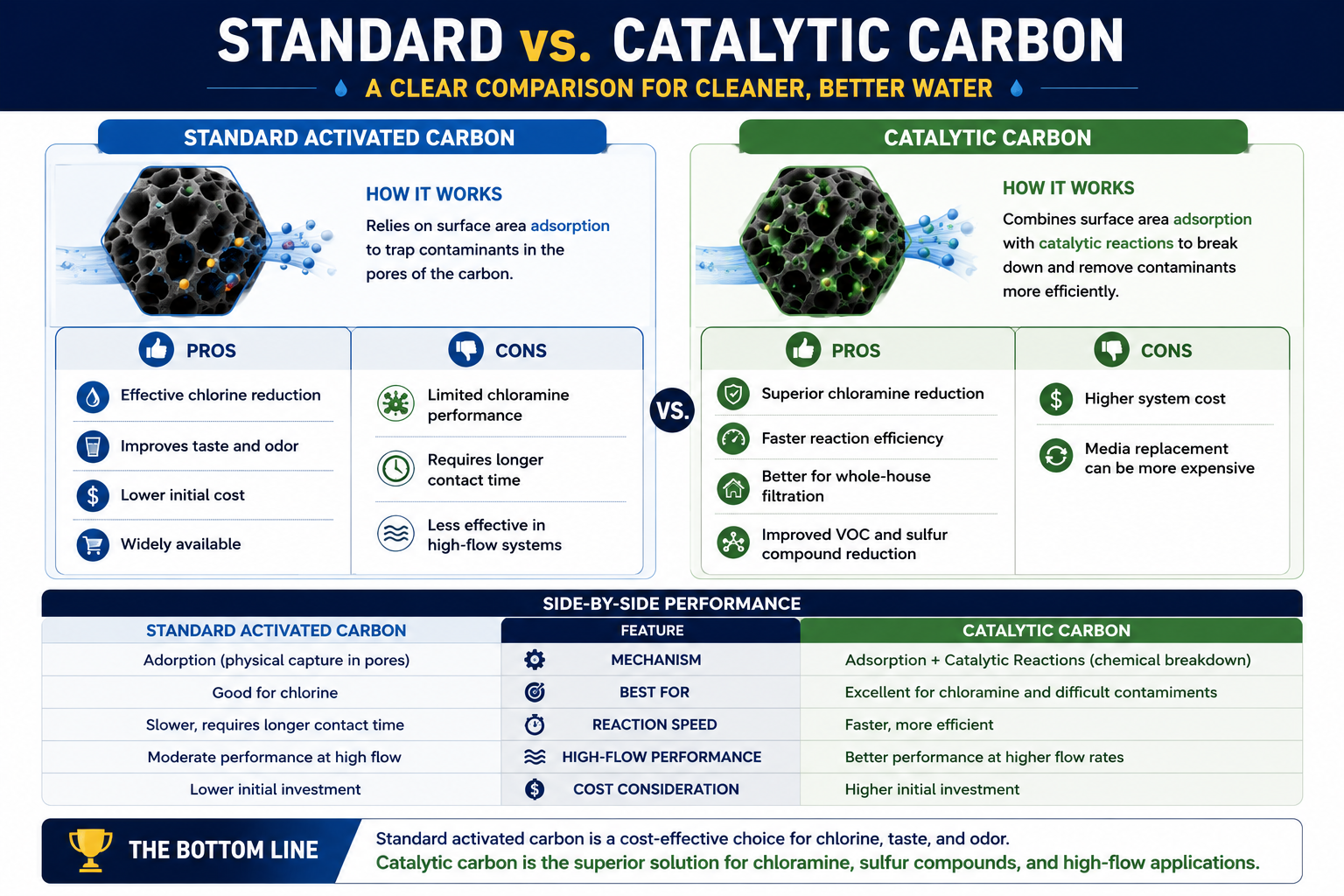
Select regular activated carbon if your water source mainly has chlorine and mild taste and/or odor problems.
Choose catalytic carbon if:
-
Your city uses chloramines
-
You want whole-house filtration
-
You need a higher contaminant reduction efficiency
-
Your water has a persistent chemical taste or odor
Many municipal systems across the United States now use chloramines instead of free chlorine, making catalytic carbon increasingly important for residential treatment systems.
Catalytic Carbon Whole House Filtration Systems at The Perfect Water Technologies
The following Home Master® systems are available:
-
Home Master HMF2SmgRFCC 2-Stage Multi-Gradient Sediment and Radial Flow Catalytic Carbon Filter — combines sediment filtration with radial flow catalytic carbon for chlorine and chloramine reduction.
-
Home Master HMF2SMGCC 2-Stage Whole House Multi-Gradient Sediment and KDF85 Catalytic Carbon Filter — pairs catalytic carbon with KDF85 media for combined chemical and heavy metal reduction.
-
Home Master HMF3SdgFeC 3-Stage Whole House Multi-Gradient Sediment, Iron & Carbon Filter — a three-stage build for households needing iron removal alongside chloramine reduction.
-
Home Master HMF3SmgNCC 3-Stage Whole House Multi Gradient Sediment, Nanofiber & KDF85/Catalytic Carbon Filter — adds nanofiber filtration for sediment and microplastics on top of catalytic carbon treatment.
-
Home Master HMF2SmgCC55 2-Stage Whole House Multi-Gradient Sediment & KDF55 Catalytic Carbon Filter — built specifically for municipal lead and chloramine reduction.
Households unsure which configuration fits their water source can submit a water test for a system recommendation through The Perfect Water Technologies’ support team.
Take Away
When deciding between catalytic carbon and regular activated carbon, the choice depends on the types of disinfectants in your water. Although the regular activated carbon does an excellent job in removing chlorine, taste, and odor from water, the catalytic carbon does better when it comes to removing chloramines from water.
Since most urban areas are switching to chloramine disinfectants, the catalytic carbon filtration is gaining popularity among homeowners due to its ability to remove contaminants fast and provide better protection from chemicals and bad odors.
Frequently Asked Questions
Does activated carbon remove chloramines?
Regular activated carbon can reduce chloramines a bit, but overall, it’s way less effective compared to catalytic carbon, since chloramines need a longer dwell time and a more capable reaction setup.
Why is catalytic carbon better for chloramine removal?
Enhanced surface chemistry of catalytic carbon promotes decomposition reactions of chloramines, and the rate of removal is rapid compared to ordinary activated carbon.
Is catalytic carbon safe for drinking water systems?
Yes, catalytic carbon is often used to reduce different contaminants and improve the water quality. It’s a straightforward material that helps with overall purification.
Can catalytic carbon remove chlorine too?
Yes, catalytic carbon removes both chlorine and chloramines effectively.
Is catalytic carbon used in whole-house water filters?
Catalytic carbon is popular for whole-house systems as it generally holds up better at higher flows compared to regular activated carbon.
Does catalytic carbon help with water odor?
Yes, catalytic carbon is highly effective at improving the reduction of sulfur-related odors, chlorine taste and smell, and certain volatile organic compounds (VOCs). Its enhanced surface properties help accelerate chemical reactions that break down these contaminants more efficiently than standard activated carbon.