
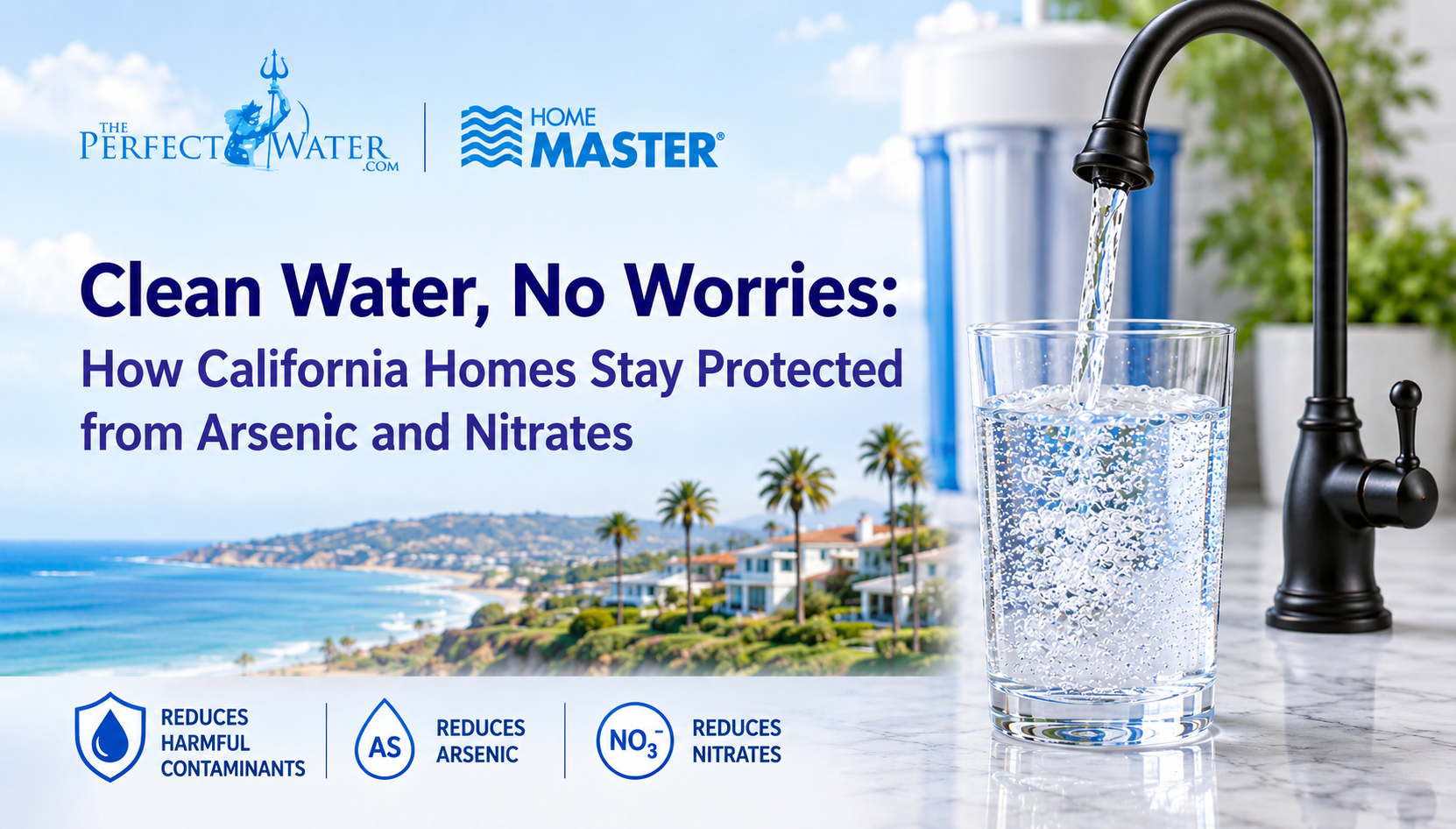
California has some of the strictest drinking water laws in the United States. However, despite these regulations, California’s water quality and arsenic and nitrate contamination remain widespread concerns throughout many groundwater sources. These contaminants originate from both natural geological conditions and human activity, and they continue to affect drinking water supplies used by homes across the state.
Routine water testing frequently reveals contamination levels that homeowners cannot afford to ignore. Residents, particularly those relying on private wells or groundwater systems, are increasingly seeking reliable long-term treatment solutions capable of reducing these contaminants at the tap.
Arsenic in California Drinking Water
Where Arsenic Comes From?
Arsenic enters California drinking water through both natural and man-made pathways.
Natural Sources
As groundwater moves through arsenic-bearing rock and soil formations, trace amounts of arsenic dissolve into the water supply over time.
Human Sources
Historic pesticide use, treated wood preservatives, mining activity, and industrial processes have all contributed to arsenic contamination of soil and groundwater. Modern industrial operations, including semiconductor and glass manufacturing, may also contribute to localized contamination.
The EPA currently establishes a Maximum Contaminant Level (MCL) for arsenic of 10 µg/L (10 ppb), which California adopted in 2008 after previously allowing 50 µg/L. California’s Public Health Goal (PHG) is substantially lower at 0.004 µg/L due to long-term cancer risk concerns. State regulators continue to evaluate whether stricter standards may eventually be warranted.
Health Consequences of Arsenic Exposure
Long-term arsenic exposure through drinking water has been associated with multiple chronic health concerns, including:
-
Skin, bladder, lung, liver, and kidney cancers
-
Cardiovascular disease and circulatory problems
-
Neurological damage and developmental effects in children
-
Skin lesions, darkened pigmentation, and thickened skin
-
Pregnancy complications and impaired immune function
One of the greatest dangers of arsenic exposure is that health effects often develop slowly over many years, allowing substantial damage to occur before symptoms become obvious.
Nitrates in California's Water: A Persistent and Worsening Problem
Nitrate contamination throughout California is largely associated with
-
Agricultural fertilizer runoff
-
Livestock waste
-
Septic systems
-
Wastewater discharge
Because nitrates dissolve easily in water, they readily migrate through soil into groundwater aquifers. In high-risk agricultural regions such as the Tulare Lake Basin, nitrate levels have repeatedly exceeded California’s legal limit of 45 mg/L.
So who's most at risk?
Infants Under 6 Months
Nitrates can cause methemoglobinemia (“Blue Baby Syndrome”), a potentially fatal condition that reduces the blood’s ability to carry oxygen.
Adults
Long-term nitrate exposure has been associated with thyroid dysfunction, reproductive complications, and increased cancer risk.
Importantly, boiling water does not remove nitrates. Effective nitrate reduction typically requires specialized treatment technologies such as reverse osmosis, ion exchange, or distillation.
For most homeowners, reverse osmosis offers the most practical and convenient point-of-use solution.
Reverse Osmosis: Home Protection Against Contaminants
Home reverse osmosis (RO) systems are among the most effective residential technologies for reducing nitrates and many forms of arsenic at the tap. However, understanding the specific chemistry of arsenic contamination is critical when selecting and sizing a treatment solution.
How RO Works?
RO systems use a semi-permeable membrane that allows water molecules to pass while rejecting many dissolved contaminants, including nitrates, heavy metals, and arsenic compounds.
A typical multi-stage RO system includes:
-
Sediment prefiltration to remove dirt, sand, and particulates
-
Carbon filtration to reduce chlorine and organic chemicals
-
The RO membrane itself, which performs the primary dissolved contaminant reduction
-
A post-filter for final taste and odor polishing
This layered approach helps protect the membrane while improving overall contaminant reduction performance.
Important Qualification: Arsenic III vs. Arsenic V
Not all arsenic behaves the same way in water treatment systems.
Reverse osmosis membranes are highly effective at reducing Arsenic V (pentavalent arsenic or AS5), but significantly less effective against Arsenic III (trivalent arsenic or AS3).
Because of this distinction, proper water testing is extremely important before relying on any arsenic treatment strategy.
In many municipal water systems, chlorination or other oxidation processes convert AS3 into AS5 prior to distribution. Once oxidized into AS5, the arsenic can typically be reduced effectively by a properly functioning RO membrane.
However, many private wells and untreated groundwater sources are not chlorinated. In these situations, oxidation treatment may be necessary before reverse osmosis.
Why Arsenic Speciation Matters?
A standard arsenic test only measures total arsenic concentration. It does not determine how much is present as AS3 versus AS5.
An arsenic speciation test identifies the distribution of arsenic species in the water and is strongly recommended when elevated arsenic levels are detected, especially for private well owners.
For example:
-
Total arsenic level: 12 ppb
-
AS5 concentration: 5 ppb
-
AS3 concentration: 7 ppb
In this scenario, the RO membrane may successfully reduce the 5 ppb AS5 portion while leaving much of the AS3 untreated. The resulting finished water could still remain near or above the EPA Maximum Contaminant Level of 10 ppb unless oxidation or chlorination is added before the RO system.
Because arsenic chemistry varies significantly between water sources, treatment recommendations should always be based on actual laboratory testing.
Effectiveness of RO for Nitrates
Reverse osmosis is also widely used for nitrate reduction and can substantially reduce nitrate concentrations under proper operating conditions.
However, nitrate removal performance is highly pressure-sensitive.
Under ideal operating conditions, nitrate reduction rates of up to approximately 80% or greater may be achievable. Factors that influence nitrate reduction include:
-
Incoming water pressure
-
Water temperature
-
Membrane condition
-
Total dissolved solids (TDS)
-
System maintenance
-
Recovery ratio
In challenging water conditions or high-nitrate applications, additional equipment may improve performance, including:
-
Booster pumps
-
Permeate pumps
-
Post-RO inline nitrate reduction cartridges
Because nitrate contamination can fluctuate seasonally, especially in agricultural regions, periodic retesting is recommended even after treatment equipment is installed.
Certification and Compliance
Homeowners should select systems certified to relevant NSF/ANSI standards for arsenic and nitrate reduction.
Independent certification helps verify that systems have been tested under standardized operating conditions and are capable of performing as claimed when properly maintained.
How a Home RO System Protects Against Arsenic and Nitrates
Standard home RO systems typically include several stages of treatment working together.
Sediment Filter
Removes dirt, rust, sand, and suspended particles.
Carbon Filtration
Reduces chlorine, chloramines, organic chemicals, and compounds that can damage the RO membrane.
Reverse Osmosis Membrane
Provides the primary reduction of dissolved contaminants such as nitrates, arsenic, heavy metals, and total dissolved solids.
Post-Filter
Improves taste and odor before the water reaches the faucet.
This multi-stage approach helps produce cleaner, better-tasting drinking water while addressing a broad range of common groundwater contaminants.
Choosing the Right Home RO System
Not all RO systems are designed equally. Proper system selection is important, particularly when treating elevated arsenic or nitrate concentrations.
When selecting a system, homeowners should consider:
Certified Performance
Choose systems independently tested for arsenic and nitrate reduction performance.
Multi-Stage Design
A minimum four-stage configuration is generally recommended, including sediment filtration, carbon filtration, RO membrane filtration, and final polishing filtration.
Water Pressure
Adequate water pressure is important for optimal contaminant reduction. Booster pumps may improve performance where household pressure is low.
Arsenic Chemistry
Arsenic exists primarily in two forms in drinking water: Arsenic III (AS3) and Arsenic V (AS5). Reverse osmosis systems are highly effective at reducing AS5, but AS3 typically requires oxidation, commonly through chlorination, before effective removal can occur. Homeowners with private wells should strongly consider arsenic speciation testing to determine the exact form and concentration present before selecting a treatment system.
Water Demand
Choose a system capable of producing sufficient purified water for household consumption needs.
Start With a Water Test
Before selecting any treatment system, homeowners should understand exactly what contaminants are present in their water.
Review Utility Water Reports
Municipal water users should review the annual Consumer Confidence Report (CCR) provided by their water supplier.
Test Private Wells Annually
Private well owners should perform comprehensive water testing at least once per year through a certified laboratory.
Perform Post-Installation Testing
Testing both untreated and treated water after installation helps verify proper system operation.
Continue Periodic Monitoring
Contaminant concentrations can change over time due to seasonal conditions, groundwater fluctuations, agricultural activity, and equipment performance.
In higher-risk areas such as California’s Central Valley, Salinas Valley, and Kern County, more frequent monitoring may be advisable.
The Bottom Line
California continues to face serious groundwater quality challenges involving both arsenic and nitrate contamination. In many regions, contaminant levels range from slightly elevated to significantly above regulatory standards.
For homeowners seeking an additional layer of protection beyond municipal treatment systems, reverse osmosis remains one of the most effective and practical residential treatment technologies available.
Home RO systems can substantially reduce many dissolved contaminants, including nitrates and certain forms of arsenic, while providing high-quality drinking water directly at the tap when properly designed, maintained, and matched to the water chemistry.
However, long-term performance depends heavily on proper maintenance. Filters and membranes must be replaced on schedule to maintain effective contaminant reduction.
The safest approach is simple:
-
Test your water
-
Understand the specific contaminants present
-
Select treatment equipment appropriate for your water chemistry
-
Maintain the system properly
-
Retest periodically
When properly implemented, a high-quality reverse osmosis system can provide a reliable source of safer drinking water for California households concerned about arsenic, nitrates, and other dissolved contaminants.